

|
|
| about | works | book (new) | articles | catalogues | links | contact | home |
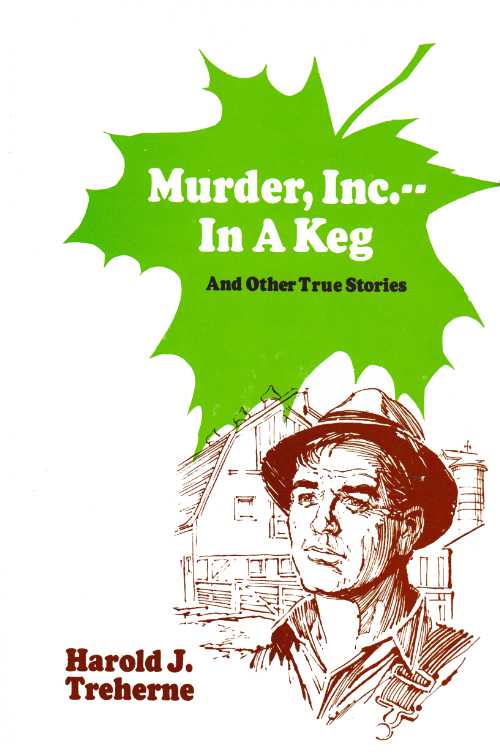
EULOGIES TO A 'T'From: Murder Incorporated - In a Keg by Harold J. Treherne |
However my father made inquiries at our local bank concerning farming prospects and one happy day I received a check which covered the price of the land, machinery, feed, 7 horses, 1 cow and a couple of pigs, also a grubstake for the first year. Now I was in the farming business. Also in the deal was a 1917 "Tin-Lizzie" which was now 9 years old but in very good shape. Actually this car wasn't in the deal. I paid $150 for it. From now on this story is wrapped around this Ford like the tin was, hence the name "Tin-Lizzie." The breaking-in period was hard on the car and the driver. I was used to the four-gate change and a clutch but this contraption (to the uninitiated) was a mess of hieroglyphics. I guess I was the simpleton, to be honest about it. Fred, the previous owner, before he packed up gave me strict instructions on how to manipulate this contrivance. Forget all about the standard gear shift, says he. Now isn't that simple? Henry Ford (the first Henry) mass produced all his Lizzies, black - millions of 'em. He jazzed up the radiators a little as time went on, in that way you could see 'em coming at you a little quicker. These Fords had a direct drive with the left pedal up, now push it down and you were in "low." The right hand pedal pushed down and you were in reverse. The side lever-and-brake placed half way and you were in neutral. Also, the left pedal half way down and you were in neutral. To start, all you had to do was release the side lever and push the left pedal down and you were away in low gear. How thrilling! I circled two or three times feeling like the head clown in a circus. I headed for the open road, pulled down the gas lever on the steering wheel, let go of the pedal and the Ford took off like a jack rabbit. What a wonderful world and the wind just whistled. I stopped, tried the reverse and everything was lovely. Slowly I headed for the ramp leading to the garage and then I forgot about everything. I slammed the left pedal down, thinking it was the clutch and the distance between the back of the garage and the Ford radiator rapidly diminished. With a bang we met head on, several boards bulged and I think the permanent crank made contact with the outside. The impact was too much for the motor. It conked out and the Lizz bounced back about two feet. My mistakes were as clear as the dawn. Luckily the damage was slight. Hoisting the top up in wet weather was a two-man job. This thing lay over the back like a deflated concertina. To activate this device, one man each side pulled out a pin and released the first bony frame, gave a real heave and endeavored to slip the holding pins into corresponding brackets in the Ford body near the front. Then the second bony frame reared up and was likewise anchored in the centre of the body. If there was a wind, look out, the fabric top threatened to depart. As for getting the pins in the holes, the one guy would get his in and the other guy pushing from the other side would push it out again. After the usual snide remarks and plus (about Henry) the Ford was still far from weather proof. Side curtains had to be snapped in place and the final anchors were two straps which were fastened to the top of the windshield. Even so the interior was about as comfortable as sitting in a field with the gate open. The Ford had one nasty habit, it was always impatient to go. Crank the motor with a little too much gas on then step aside quick and catch it on the fly. I soon wised up to this. I didn't intend to be flattened against the back of the garage like a pancake. A six-by-six placed the right distance from the wall of the garage curbed its appetite for vengeance. There were two fine points to remember when starting the Ford. Make sure the spark lever was retarded on the steering wheel otherwise it would kick like a mule and it was no use swearing at it, it thrived on such compliments. Just make sure you were still in one piece. The other point was of course making sure the six-by-six was in place. Starting the Ford in cold weather when it was below freezing required a lot of ingenuity (you didn't need a B.A. degree those days). You just used the old "noggin." (I hate that word!) I must start a new paragraph for this! First of all you try the crank and always pull up and if your knees are starting to buckle and the crank remains in the status quo there is just one obvious result. The Ford has arthritis in all its joints. So you look around for a jack. They were made in those days but I don't remember what they looked like. Now jack one hind wheel clear of the floor. This takes half the load off the crown gears if the grease is very stiff. Now, pull the priming rod out to the front and leave it there then slip round and tickle the carb. A short vertical rod worked up and down and you can hear a little tinkling sound. That's extra gas. Now grab the crank, push it in to engage, put your thumb underneath and hold your breath and hope. Give a heave upwards and you are happy that the motor turned over. Try again and the third time there is one H. of a bang. Shove the choke in quick. The noise in a confined space is shattering. The wheel on the jack is whipping round like crazy so keep out of its way. Jump in to the driver's seat and jab the pedal gingerly in to low then let go. Otherwise you will stall the motor. Now lower the wheel to the ground and there you are. Another delightful chore (pardon my sarcasm!) peculiar to the Ford was checking the oil level. Everybody who owned a Ford had to do this, whether of high or low standing. Those little skate boards with the little castors weren't around in the Twenties. There were two taps on the flywheel casing, one above the other, and in no circumstances was the oil allowed to be below the bottom tap and not above the top tap. So wiggle underneath and check, which meant sliding under the mudguard. Between the mud and the extra oil you finally achieved the desired result, then you went to the house and cleaned up. One Saturday night I was headed for Central Butte for a sack of twine. It was harvest time and it was ten miles to the Butte. How that Ford took the bit! One touch of the throttle and the motor threatened to leave the body. In this wise and four miles from home and really in tune with my superb Ford — it happened. Suddenly it went crazy and zigzagged all over the road and the back end on the right side sagged to the ground. I viewed the road from a decidedly lower perspective. Its giddy maneuvers ceased and it subsided forlornly on a tireless and stubby axle. All the spokes had disintegrated and the rim and tire had sought refuge in some unknown hideout. Like a lame duck, there it was, my pride of a few minutes ago and I could have wept - Caesar did - but I kept a stiff upper lip. Finally I ended up by staying the night at a bachelor neighbor's place and grieved over my automobile sitting on the main thoroughfare entirely hors-de-combat. The next morning I walked across the pasture to the road to view the remains and my grief turned to exploding fury when I discovered some fly-by-night had filched an almost new tire from a front wheel. I had it all together eventually and drove home sadder but wiser. I never found the culprit, of course. There is another little incident worth mentioning (not serious) concerning five gallons of the best. The front seat is hoisted out and there is the gas tank. The hardware man put in the five gallons and home I went. I noticed it missed once or twice but I closed the garage doors and forgot all about it. The next morning was the Sabbath and to think that this should happen to me on Church day was just too awful to contemplate! I went to start Liz about 10.15 a.m. and No, sir, nothing doing. I cranked and choked the carb then reversed the procedure till I finally choked myself. I raised a few blisters in the bargain then brains(?) took over from brawn. This stuff wasn't gas, it wasn't water, it was coal oil! That hardware man was in for it. My wife and I missed our hour of quiet meditation. I felt like a complete heathen for a whole week. There was one other little adventure with a little Ford coupe of the same vintage. It happened on a neighbor's farm during harvest. They were very busy and I offered to go to the village (two miles) for groceries. It was after dark and I circled round to the road and there full in the head lights was a "Titan" tractor. How did that get there? Should I go round it, under it or over it? I compromised and went "up" it. My wits left me for the second time and one of the extended lugs on the big wheel of the tractor caught the Ford's tie-rod. I was on the way to heaven till Jack stopped the tractor. The Ford suffered a bent tie-rod. My lady didn't get her groceries and I suffered a bent ego. They were very nice about it. The Ford headlights received juice from magnets in the flywheel. In time they weakened and their eyes suffered from old age, which happened to mine. To get enough light you had to go hell for leather or stay in low gear. I changed all this. In Central Butte I had the magnets recharged and in place of the 21 C.P. bulbs I put in 32 C.P. Now I had light to spare. "Let there be light and there was light!" My pardon! Now the bandages were off its eyes and other cars meeting me after dark really slowed up. Those superior models, weren't they chagrined when they realized they had showed courtesy to a Ford? Care had to b e taken when traveling in low not to speed up, otherwise bing go the lights! There were hundreds of gadgets put out for the Ford by private concerns but Henry never changed the model till about 1928. The one over all criticism (taken in jest) was "Put another spring in the back seat, Henry." I believe the Model "T" Ford has been the aim and butt of
more quips, jokes and sallies than all the rest of the cars put
together, in its day, of course. In spite of everything, I
enjoyed my 1917 Ford and when its usefulness was over it
seemed like the loss of an old friend. It was in the early
Thirties and I took the motor out to overhaul it. It was never
put back in again. The hard times hit us and I couldn't afford
to run it. The motor minus pistons and so on was sold for
scrap at the rate of 15 dollars a ton and so after five years
and an investment of 150 dollars I realized a couple of bucks!
|
| about | works | book (new) | articles | catalogues | links | contact | home |
 n 1926 I acquired a half section of land (320 acres) in
Saskatchewan. I had worked out all around the neighborhood
for three years but I was still just a hired man and was hoping
to get a place of my own. I really liked the prairie and the
prairie folk. Then this half section came up for sale. I had
already been back home twice in the Winter time but the
prairie always called me back. My father couldn't understand
what the attraction was but from his vantage point in
England and being a successful businessman I could appreciate his opinion. I had a little money put by.
n 1926 I acquired a half section of land (320 acres) in
Saskatchewan. I had worked out all around the neighborhood
for three years but I was still just a hired man and was hoping
to get a place of my own. I really liked the prairie and the
prairie folk. Then this half section came up for sale. I had
already been back home twice in the Winter time but the
prairie always called me back. My father couldn't understand
what the attraction was but from his vantage point in
England and being a successful businessman I could appreciate his opinion. I had a little money put by.
