

|
|
| about | works | book (new) | articles | catalogues | links | contact | home |
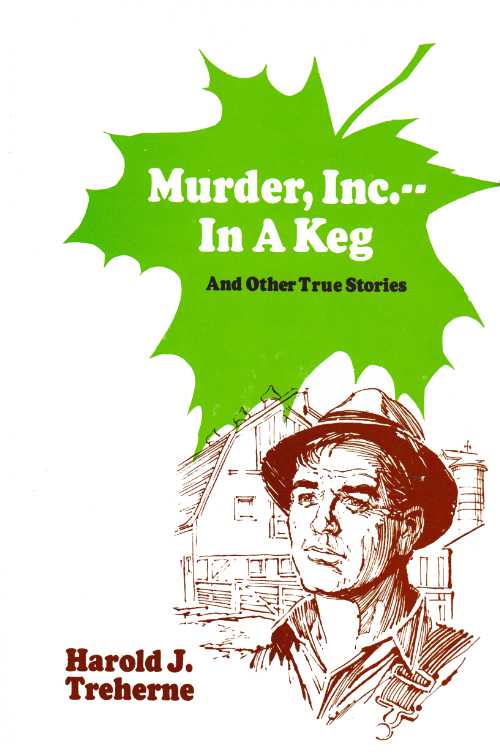
THE BREAKING POINTFrom: Murder Incorporated - In a Keg by Harold J. Treherne |
Anyway there it was, a low-slung affair, didn't have to look up at this one, down was the key word. A man's level eyesight slid clean over the top. Procedure for entry was a little complicated. A stoop was called for, like you were in a Salaami stance, now proceed carefully straight ahead, lift your knees and you are in. You take the driver's seat. Now, your wife follows, there being only one door and as she is comfortably shorter she doesn't have to follow too closely the "guide for entry" routine. You notice how comfy this is, a perfect fit for two as long a s you are both "unfrustrated" and amenable. It was impossible to stand up more than half so I had a notice put up: "Please do not stand while this vehicle is in motion." We had just the team for this two-by-four creation, quiet and understanding. Nip, a chunky Clyde and a good stepper always was reliable. Tuck, his stall mate, always was a hanger-on. He was born tired and pardon me for saying that, my erstwhile friend. He should be a long liver! He traveled just as fast as Nip but about a foot behind. Tape line finishes didn't mean anything to him. Anyway, all you saw when Nip and Tuck were hooked up to this outfit (and they were hooked) was Nip and Tuck. You didn't see that red thing till afterwards. I believe Nip was so ashamed about it, that's why he ran so fast-trying to get rid of it. Tuck just didn't care, his energy was taken up just running. My wife and I were visiting neighbors, two miles away this afternoon in the Winter time. We had taken to the fields dodging this way and that to avoid big clumps of dead and wiry Russian thistles. These showed up in our district in 1924 for the first time. It was in the dirty thirties when they made good time. This episode took place in 1930 which was another poor year for grains but thistles thrived on little moisture. The little red cutter proved itself worthy and a paradise for two. There wasn't much snow which was another reason why we were on an erratic course to avoid the bare spots. We enjoyed our visit and soon after supper decided to leave for home. We said our adieus and thanked them for supper, the team was hooked up and we headed across the road taking to the field again. Behind us shines the pale horizon, slightly tinted in crimson as the sun, lost to sight throws back his tattered fading streamers. The full moon, his face inscrutable, hangs suspended in a sea of varied blue. Rising high he centers himself triumphantly in a huge aura of blue-white light where the stars are forbidden to enter. Beyond its indefinable limits, points of light, embedded in the deeper blue, blossom in myriad profusion; exulting in limited segments of space. I have tried my hand at the sublime, now for the ridiculous. Into this enchanted setting we slid away but I lost the previous trail. It does happen and we found ourselves in and surrounded by a no man's land of dark lumpy looking objects. Through the windows and each side of the team, I could see them. There was a mysterious swish and crackle behind the horses' feet. This must have been a different texture of snow. Musical sand, then why not crackling snow? The horses were slowed from a trot to a walk. Something here was not according to Hoyle. The team were lugging harder and I could see their heads dropping lower and their rounded rumps crinkling. Some practical joker, the blighter, must have hooked on the back end we were caught in the middle of a tight draw. This was ridiculous (see what I mean)? Then what was it? With a loud bang like the crack o' doom, conjecture ceased and the lines (reins) paid out of their small openings with the speed of a farflung fish line. I salvaged the last six inches and the team were about ten feet ahead. This was a real break for Tuck. He was ecstatic. We were about half a mile from Syd's place. My wife thought I should get out and investigate. I am sorry I didn't think of it first. I ducked my head low and dived out. With one mitted hand supporting my stubbly jaw (that's incorrect, I am now married), I could see a hardpacked wad of Russian thistles jammed in front of the cutter forcing it right up to the horses's feet before they broke away. This was a clear instance of Russian sabotage on the Rural Front! Looking behind for over one hundred yards I could see a
perfectly smooth path of snow, cutter-wide glistening in the
moonlight, flanked on either side by acres of black shadowy
warting for their next victims. We walked the team back to
Syd's, stayed there the night, renewing old acquaintance and
started out the next morning with borrowed double-trees.
|
| about | works | book (new) | articles | catalogues | links | contact | home |
 hat bright red cutter body never did measure up, too
small for one thing. The old high-backed, whip-holstered,
nickel-railed, plush and fancy'd open air body was discarded.
This typified the times, the epitome of gallant romanticism
where the nippy air cooled the fevered brow of some
love-sick swain. But not for me! I conjured up a neat little
affair for two, all enclosed, with windows in the back and
front. After two years married I still plumped for seclusion
and pitted my puny knowledge against all common sense
ideas by slapping up this cute little contraption. How
mooney can a man get?
hat bright red cutter body never did measure up, too
small for one thing. The old high-backed, whip-holstered,
nickel-railed, plush and fancy'd open air body was discarded.
This typified the times, the epitome of gallant romanticism
where the nippy air cooled the fevered brow of some
love-sick swain. But not for me! I conjured up a neat little
affair for two, all enclosed, with windows in the back and
front. After two years married I still plumped for seclusion
and pitted my puny knowledge against all common sense
ideas by slapping up this cute little contraption. How
mooney can a man get?
