

|
|
| about | works | book (new) | articles | catalogues | links | contact | home |
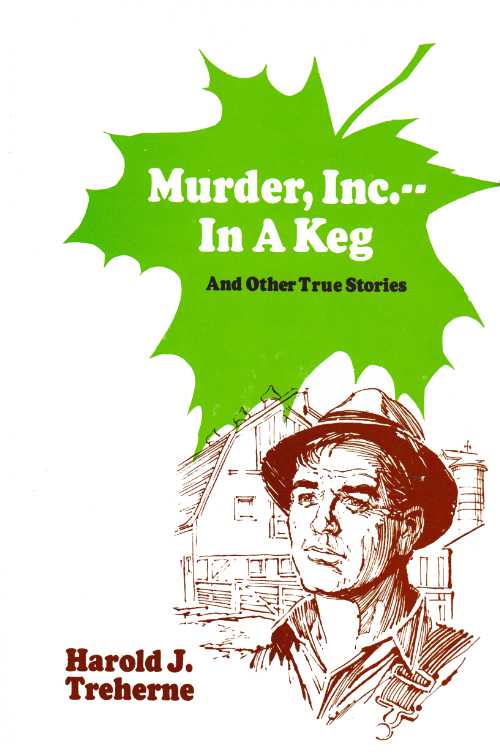
TORNADO OF '26From: Murder Incorporated - In a Keg by Harold J. Treherne |
I was hired by Bob for the Summer. August the 4th was a Saturday and besides being the anniversary of the beginning of the First World War it was also a day to be remembered by certain prairie dwellers in South Central Saskatchewan including yours truly. This was my third Summer working out. This Saturday was hot, just typical o f the many days gone before. The sun rose out of a cloudless sky, a big red ball sitting for a brief span on the rim of horizon. As he cleared his apparent resting place and climbed into space his rosy face perceptibly diminished and paled. His rays intensified and reaching his zenith seemingly further reduced in size, he was just a ball of concentrated fire and energy. Gaze at him a second and close the eyes and into the darkness loom misshapen suns in the primary colors with violet, purple and orange tints added. A rough indigo, red, deep red or blood red dado surrounded him, touched with intricate and delicate color tones. By noon it was a scorcher and stones and metal objects were just too hot to hold for more than a few seconds at a time. Shimmering waves of heat harassed the standing grain and the prairie wilted under an oppressive haze. Mirages converted the receding road into a narrow band of shining and dancing but deceptive water; follow it and it retreats. A carpet of rolled up light relaid and relaid again and again, its mood synchronized to your own. This was the ideal breeding ground that spawned the tornado which was unleashed before midnight. A fair wind born in the East blew steadily later in the afternoon. After supper and this being Saturday, on this one night always we hied ourselves away to the village three miles distant to celebrate. Some, letting off a powerful head of steam, just soaked themselves good and drunk; others, not so rambunctious, played pool and innocent whoopee while the rest mingled with the crowd seein' all an' sayin' nowt, which wasn't strictly true, of course. We enjoyed chinning over the week's happenings and always the glib talker and spokesman for every hired hand shows up without fail. To a listener ready and willing to hear him out he's good for thirty minutes of fact, maybe embellished with a little phantasy. Sure a hog jumped out of the pen, he never got out before but anyway he nailed two more boards on; he had to hunt around for 'em, there were lots of old boards round the joint; he told Jim he should get new ones, these others were half rotten anyway. "The boards were up five feet now and that same day at supper time, blow me if this 'ornery 'og wasn't out agin. He took some getting back in too but he follered me and the old slop bucket. He wasn't follering me exactly neither which is a good thing although I got a swooner of a hog voice. 'Ogs (and sows too) just fall for me right an' left. I used t'use it in the Old Country so I put it up to seven feet and I see that 'og the next day how he done it. He took a good run at it and with a whoosh up 'e goes like a hobtailed cat shaking off a terrier, then over the top and he's gone. Jim shut 'im up by hisself and put a roof over 'im. That fixed that leaping lizard." See what I mean? Then he would come to cows, and horses if you were listening. Bob, as a member of the Church Board, had to attend a meeting in the village this Saturday night. Around 8 P.M. then, Bob, myself and his versatile "Tin" hit the road to the village and I would seek my own pleasures. It wasn't dark by any means and the sun had gone down a blazing red. Thunder heads in the Northwest, black and jagged, were already showing up. The East wind persisted, a little fresher and the grain rustled and shivered before it and also with the wind had gone the oppressive noon day heat. Can't say that I liked the look of things; however here I was free a s a breeze and I pushed my way into the jammed pool room which now is known as a "pool hall." The tavern of the old days became a "beer room," a "beer parlor" or a "beverage room." Why not call it a beer joint and quit juggling terms? In the pool hall I promptly became lost and obscure as a shadow in the rank pall of tobacco smoke. Dodging the oscillating cues and every moving color in Jacob's coat I found myself a seat. The steady buzz of conversation sparked by many curses, horse laughs, hoarse ditto and clicking, capering billiard balls represented the acme of enjoyment and relaxation in those days. I became the target for the butt ends of billiard cues and leaned over this way and that and was blotted out by the close proximity of the players. Everyone to his own bent and soon I elbowed my way out and that incessant innocuous drone simmered to a whispered buzz as I closed the door and gained the great outdoors, truly a dilly after that helly place. I played billiards but that game seemed to be a lost art and it could be my slight resentment was unreasonable. It was quite dark now but not so in the Northwest. The ominous outline of dense black clouds was clearly visible as flashes of lightning seethed and forked behind them in fairly quick succession, reddening the mass in dull fire. No thunder could be heard at the moment. It was a silent yet potent and awe-inspiring display of elemental forces. I walked the main street for a few minutes but window gazing and small talk just didn't fit in. Compared to the stupendous forces gathering around and which were edging ever closer, man seemed but an insignificant cog. Soon I heard a long low rumble of thunder as from a great distance steady and unbroken. The lightning took on a grim yellowish tinge and the way it spurted flame and leaped amongst those clouds gave me a feeling of apprehension. It must have been about 10.30 p.m. by now and I was ready to hit the trail South anytime. Bob must have had the same idea because he showed up in a few minutes and we were soon hightailing it back to the homestead. The devil's own brew was on the menu tonight and somebody was going to have to pay for it, like it or not. The lightning display was a spellbinder. It silhouetted buildings, trees and fields of grain in sudden relief then instantly everything was blackish as the tomb, intensifying for a second the yellowish beams of the head-lamps. They showed the straight and dusty road in puny and meagre light and again immense flash bulbs turned night into blue day and once again the Ford's eyes suffered instant blindness. The Thunder rolled down the heavens in cascades of bursting and overflowing sound, its dying reverberations obliterated, drowned by new approaching thunderous avalanches. The East wind had increased his tempo a little and was driving himself apparently head on into the storm. The cloud masses rose against him, relentless and overpowering and the lightning fueled and spurted from black stewing cauldrons of cloud. He was priming for the kill. We made a quick turn East through the gate and Bob ran the Tin Lizz under cover. Home at last and home is where you make it. All at once almost unnoticed the wind had died, had given up the unequal struggle and a dead calm prevailed. The all-pregnant lull before the stillness of the night is violently shattered. But the night at the moment was as still as a becalmed trader, as quiet as the glassy surface of a mill pond and a candle lighted in the night would point his little flame to Heaven, the minute and thin wispy thread of smoke ascending upright and leisurely, while yet over there to the West those hounds, still leashed were baying on the heels of night. Mr and Mrs R lived in a sod shack at the time. (A two story house was built later.) A granary twelve feet square was set up on two-foot blocks on the West side of the shack. The space between it and the shack would be at least two feet. This was my bed-sitting-room for the Summer, mostly bed. West of the granary, twenty-five yards away or so and a little North was a haystack. A wagon and rack was close by. Aside from the usual paraphernalia round a farm yard such as tubs, slop pails, a few loose boards, cats, kittens and dogs - anything movable - this was the pertinent set-up this Saturday night. It was now about 11 p.m. and the three of us looked the situation over with an amateurish eye and a scared one, at that. We couldn't do anything about it so, after the usual "Good night" (blindly optimistic) and within a few minutes I was retired for the night. (I hoped.) The oil lamp flickered, instantly revived and finally snuffed out under a deflected blow from the palm of the hand, leaving a distinct stink and no kiddin'! This was the farm; horses, cows, pigs, chickens, hay, Tin Lizzies, coal-oil and lamp wicks and their aromas, smells and stinks all part of it. With these sensory delights imagined and real, I dozed off but it was a mighty skinny nap. I was caught with my pants down, all right. In an instant and with a start, accompanied by terrific noise, I woke up to find everything moving as my granary under the battering wind tipped and its eaves banged the shack. The bed with me steering (sitting up) took a trip to the other side. To keep the record straight I won't swear to this last statement although the table slid across. I was sitting up in the dark waiting for the next thrilling installment when the mad wind after its first onslaught paused to regroup its forces. The granary eased back, oh so gently on the bosom of its boisterous parent, tipped the other way as it fell off the outside blocks first then finally settled on an even keel. I was now two feet nearer sea level. It was like all hell let loose outside as the crashing thunder and hurricane winds battled for noise supremacy and flash after flash of lightning lit up a scene of destruction. Almost immediately after these antics were through Bob banged the door and breezed in carrying a lantern. I greeted him, still sitting up in bed and assured him I was all right and we had to holler to make ourselves heard. It was perfect pandemonium outside that door; as for the inside it was one deuce of a mess. All the dust that had ever collected since the granary was built was on me and the bed. Handfuls of hay were driven clean through cracks in the siding; it was on the floor, on the bed and could still be pulled out of the cracks from the inside where it had lodged as the wind eased up a little. I looked like a dusty miller and felt like one. At Bob's request I donned my faithful overalls and we retired to the shack to await further developments and I spruced up a little while we waited. The wind and thunder screamed and rattled; the lightning untiringly threw up his Verey lights and the Nor'wester roared past loaded with dust o n a rampage of destruction. There was no rain yet and the air was bristling with static electricity. The ground, down to China, was dry as dust and a spark now or a bolt could start a raging inferno. We didn't need to worry about that as, suddenly above all the other noises, came a familiar but unwelcome dull thud on the roof followed by other spasmodic conks, then silence. All the other racket going on was hushed to a whisper, as an ear, attuned to certain ominous sounds sifts and throws out any other interference. The impact of a hail stone on the roof had its countereffect on us as mentally we ducked in apprehension. The crops though less than average were at stake and one good hail storm could write "finis" to the year's work. Then with no more palaver the clouds let loose their icy bombardment and the hail, wind-driven, pounded the shanty roof in swift pummeling staccato intensity, like a thousand muffled hammer blows. A bunch of berserk skeletons toe-prancing in mad elation couldn't have done a scarier job. It's a wonder the old roof wasn't stove in. In less than two minutes except for the odd stone the hail was over. They were pullet egg size. Then the rain came in similar fashion, easy at first and with the odd hailstone but in no time at all there were sheets of it billowing in the wind, plopping, splashing and bouncing and, like handfuls of shingle nails thrown at glass it pecked at the windows, cascaded down in thin interlacing streams, ousted the dust, shivered on the sill, slid off and in almost horizontal fashion departed on wet and speedy wings. After a time it settled into a heavy downpour and the wind continued its savage driving most of the night, but the rain-child becoming a little more docile later, in contrast to its noisy and lit-up parents wept till early morn unconsoled. Again I took to my granary bed after cleaning up and in serener peace of mind. Nature had shot her bolt; done her damnedest, you might say, and I lay down with the assurance that the morrow would be a better day. Sunday came and the sun rose in a blue and rain-washed sky and it was like stepping out into another World. After the thorough scrubbing over night everything was just sparkling and the sun gloried in spaces washed, combed and dried. Breakfast over we surveyed the damage and Bob could consider himself lucky, I thought. A third of the haystack left home without permission and on extremely short notice, a fraction of it seeking sanctuary in my bed-sitting-room. The rack and wagon parted company but if the rack left the premises I couldn't swear to it at this date, thirty years later. The wagon ended up on its side however and I do remember Bob talking about a chain. He had the wagon and rack anchored together. He was wise before the event. The rack without a doubt would come off second best. Another granary near the road loaded with several sacks of cement in one corner, amongst other things, was slewed round three or four feet. This doesn't appear worthy of note except for one thing. The corner where the sacks were almost split the wind evenly and a little study in mechanics would show the resultant force at right angles to the side would be only a fraction of the direct force of the wind, hence the enormous wind velocity required. As for the smaller things mentioned earlier just lying around, they departed this life and never came back to tell the tale; although again a small pig trough or it could have been a bathtub shows up faint in my memory. It it was the trough it was of no importance but the other is a horse of a different color. The loss of the tub could b e a calamity of far reaching proportions. To think that the galvanized tub with its inseparable ritual, the weekly bath, was lost for ever is a thought that won't bear dwelling upon. I can quite understand a thorough search being made for this, even to the extent of calling in all the neighbors. I refuse to think too deeply on the subject. The whole West could s(t)ink to animal level but for this indispensable adjunct. Certainly Bob could have bought another but every time he saw it think of the heartache he would suffer on the loss of the first bought. Round or square tub nostalgia is a potent force. A mile and a half North and East of us a hip roof barn, 40 by 80, took off; everything went and the shingles seeded the countryside a bushel an acre. A car traveling West was stopped in its tracks. I guess nobody was acquainted with Petrox or Ethyl in those days. Dynamic V8 engines, high compression and supercharged with Petrox weren't around these parts then. The wind provided the dynamics. It was cheaper. Gas in those days did the job without complaining but it knocked and fizzed out under a slog on the head like this. Just couldn't take it. It was probably a Tin. (What other make was there?) The argument i s now closed. One incident West of us I remember. Sandy and his hired man Bert (a pal of mine then) returned home just after we did. They had a mile West and half a mile South to go after passing Bob's place. They were really hightailing it going West in an effort to beat the storm; we saw them pass. Sandy's place had trees on the East, North and partly on the West side. His garage was built flush with the trees on the East side, a neat and secluded spot. They congratulated themselves on having beaten the storm and had pulled up right opposite the garage doors. Bert moved fast to open the door and almost touched it but the wind beat him by a narrow margin. The garage took off into the trees and its former resting place knew it no more. Coming nearer home again, in fact just across the road, were signs of other casualties, victims of the storm. Three miles of the main telephone lines were down all the way back to the village, their heads resting comfortably along the edge of the road. Billie, the linesman and head push, was having the time of his life, tapping the wires and giving out vital information to all the party lines: "Three miles of telephone poles down - all busted." He was just across the road and I can hear his "All busted" yet. He had a pleasant rather musical sounding voice. All the villages and hamlets in the storm's path suffered a common loss, including the farms, too. They were deprived of their toilet facilities, those little monuments erected solely in honor of John Q. Citizen and dedicated to his supreme comfort. The wind played fast and loose with those heavens of rest but honestly I don't believe that a certain occupant was caught with his (or her) pants down and lost his (or her) seat into the bargain. Probably his (or her) seat went with him (or her). In any event it was a Halloween trick on a grand scale and a shabby one that the storm pulled off. It almost developed into the No. 1 emergency but nothing was done about it. It was too hush hush. There is not much more to say. The crop was badly battered, a lot of it lying down. The wind and rain I think did as much damage as the hail. Bob, like all the other farmers in the storm area, cut the
crop and threshed it. It averaged about five bushels an acre
but as Bob said: "It's a next year country".
|
| about | works | book (new) | articles | catalogues | links | contact | home |
 he month of July 1926 was hot and I mean hot, 80, 90
and above in the daytime. Although there were heavy and
frequent thunderstorms in June, July was mostly dry with
day after day of simmering heat. There could have been some
rain but it didn't help any. The crops were suffering and were
slowly but surely being cooked.
he month of July 1926 was hot and I mean hot, 80, 90
and above in the daytime. Although there were heavy and
frequent thunderstorms in June, July was mostly dry with
day after day of simmering heat. There could have been some
rain but it didn't help any. The crops were suffering and were
slowly but surely being cooked.
